I think some are missing the point of the emergency. It is NOT to disrupt lives of the innocent. It is to bring order to a political climate that was out of bounds in the late part of last year.
In the initial stages at times the Emergency Powers were used a bit indiscriminately. However as time passed and rule of law established itself then the unintended damage it might have caused have come down. Due process that we were shouting about in the early months of this regime is something that is now being adhered to.
Again I am not saying whatever the CTG government is doing is the best, but it is making an honest, sincere and well-intentioned effort to make amends for the past mistakes.
The two examples that Nazzina has brought up are good. [ Pls refer comments of the post Do I Stand Behing the CTG?] Because in case of Mr. Richil an investigation has been put together. I believe his body was exhumed for another autopsy. Those responsible for this gruesome incidence will be bought to justice.
In case of Tasneem, the authorities maintain that he was NOT detained for his journalistic work, but rather because of receiving huge amounts of unexplained overseas funds. According to published transcripts it appears that he was planning to use that money to fund anti-state activity. Now I am not saying it is true or not. Tasneem never cleared it to me. [Incidentally I have tried to contact Tasneem many a times. I have left messages, sent sms and emails. I have been in direct contact with his father who is worried about his son’s welfare. Tasneem has decided to remain incommunicado. Hence the disclaimer and the benefit of the doubt rather than a full frontal attack on reported transcripts.]
As some of you know, public perception in Bangladesh is often tracked through opinion polls. Our studies have shown very high approval ratings for the CTG. Which brings me to Tanvir’s point. You are right CTG does not have an election that it needs to win. But to ensure that the reforms brought in are successful in the long run, it still needs to win the hearts and minds. For that they need to ensure that the citizens of our nation are fully behind the decisions taken. In my mind one of the shortcomings of the CTG has been to clarify the reasons for decisions they are taking.
Of course not having an election to be answerable to also allows the CTG not to be a populist government (as opposed to a popular government.) Some hard but necessary decisions can be taken and implemented. Take for example the Chittagong Port. Years of corruption and misuse have been reversed in matter of weeks. Productivity of the Port are at all time high and decisions are being made on the future of our export gateway.
I think it is a misunderstanding that we believe that arrests will be made if everyone of us speak out. That is not true. Bangladesh enjoys a high level of press freedom. I am at times amazed by the harshness of a lot of reports I read in many papers or hear on TV. Till date no one has been arrested for an opinion they have had. As explained in the Tasneem’s incidence, it is for his other alleged activities that he was questioned. Not because he had an opinion about the CTG.
In absence of any political opposition, it is journalist and blogger like us who can constructively critique the government. This will help them to moderate their actions and benefit from the collective wisdom of this nation’s quite capable human resources.
Supporting any government cannot be done blindly. Neither can opposing it. Decisions need to judged on merit of that particular case. Many progress have been made and many more remain. Some have gone to our liking, some have not. But at the end of the day we have a CTG that is dedicated in its effort to bring order and prosperity to our nation. And till that remains their objective, they have my full support. And I hope the support of every citizen who wants the same.
Tuesday, June 12, 2007


Monday, June 11, 2007
Do I stand behind the CTG?
A reader of my blog recently asked me
So you basically you stand behind each and every wrong doings this government is doing?
I think this needs a proper answer instead of being hidden in the comments section. So here goes:
Do I agree with each and everything my parents do? Or for that matter my sister? Or my wife? Or my friends? No! Do I stand behind them and support them whole-heartedly. Yes. Do I wish for their success? Do I hurt at their failure? Do I give them advice or a shoulder to cry on? Do we promise time and time again to hold hands and do the best we can? Yes, yes, YES!!
Do I agree with “each and everything” the CTG does? Of course not. They are making mistakes. Some silly, some serious, some willing and most unwillingly. But are they on the right track? Most definitely. Are they better than the alternative? (though it is setting the bar very low) Does anyone have any doubts?
Given our circumstances now, I think the CTG is doing its part in bringing order where there was chaos, in bringing peace were there was confrontation, in bringing patriotism where there was individual thievery, and in bringing hope where there was despair. At times they are succeeding. At places they will stumble. It is a lot of ill, a lot of dirt, a lot of filth that one needs to clean up. For every 10 task they undertake, maybe they will not get a few right. But as God is my witness I am so happy that they are doing what they are doing rather than the nightmare that waited us a few months back.
But it is not their task alone. Each one of us has to ask what part we can play in the effort. It is easy to criticise but when it comes to doing, it is a different ball game. Are we all ready to play? To paraphrase JFK “Ask not what the CTG can do for the country but ask what you can do for the country.”
So you basically you stand behind each and every wrong doings this government is doing?
I think this needs a proper answer instead of being hidden in the comments section. So here goes:
Do I agree with each and everything my parents do? Or for that matter my sister? Or my wife? Or my friends? No! Do I stand behind them and support them whole-heartedly. Yes. Do I wish for their success? Do I hurt at their failure? Do I give them advice or a shoulder to cry on? Do we promise time and time again to hold hands and do the best we can? Yes, yes, YES!!
Do I agree with “each and everything” the CTG does? Of course not. They are making mistakes. Some silly, some serious, some willing and most unwillingly. But are they on the right track? Most definitely. Are they better than the alternative? (though it is setting the bar very low) Does anyone have any doubts?
Given our circumstances now, I think the CTG is doing its part in bringing order where there was chaos, in bringing peace were there was confrontation, in bringing patriotism where there was individual thievery, and in bringing hope where there was despair. At times they are succeeding. At places they will stumble. It is a lot of ill, a lot of dirt, a lot of filth that one needs to clean up. For every 10 task they undertake, maybe they will not get a few right. But as God is my witness I am so happy that they are doing what they are doing rather than the nightmare that waited us a few months back.
But it is not their task alone. Each one of us has to ask what part we can play in the effort. It is easy to criticise but when it comes to doing, it is a different ball game. Are we all ready to play? To paraphrase JFK “Ask not what the CTG can do for the country but ask what you can do for the country.”
Mahi B. Chowdhury's Stand
This morning Mahi B. Chowdhury resigned from his post at the Orgainsing Secretary of LDP as well as his Presidium post. His stated reason was that he was not elected to those posts. And if reform is to happen, and LDP or he is to talk about it, how would it look if they did not lead through example.
And it is a great example Mahi is putting out. I believe such a pro-active step is a sign of what the younger generation can bring to the table. I am at this intant not getting into Mahi's or LDP's politics (or their agendas). But what it shows is the willingness to reform. The willingness to accept the responsibility of making a mistake in the past and setting the agenda for the future. I do hope others will lead by his example.
Best of luck to Mahi B. I hope this is a sign of him maturing into a great leader.
Update: Mahi B. Choudhury launches a "platform" titled The Reformists. I belive it is not a political party but rather a "movement" to generate reform within politics itself. I look forward to seeing what he has up his sleeves.
And it is a great example Mahi is putting out. I believe such a pro-active step is a sign of what the younger generation can bring to the table. I am at this intant not getting into Mahi's or LDP's politics (or their agendas). But what it shows is the willingness to reform. The willingness to accept the responsibility of making a mistake in the past and setting the agenda for the future. I do hope others will lead by his example.
Best of luck to Mahi B. I hope this is a sign of him maturing into a great leader.
Update: Mahi B. Choudhury launches a "platform" titled The Reformists. I belive it is not a political party but rather a "movement" to generate reform within politics itself. I look forward to seeing what he has up his sleeves.
Wednesday, June 06, 2007
Mastery of Self: A playshop that will change your life
As some may know our company Nazimcorp Resource Gateway is involved in bringing various human resource and self development training / programs to corporates in Bangladesh. Amongst the most popular is the Mastery of Self playshop conducted by Ranjan D'Silva. It uses NLP (Neuro Linguistic Programming) to help oneself overcome obstacles in life and achieve - for want of a better word - enlightenment. Sort of finding ways to "re-wire" yourself to help you set and achieve goals. I personally have done this course not once but twice and believe it is really an effective program. I would wholeheartedly recommend it to all.
Due to popular demand we have organised a public playshop (as opposed to only restricted to one company!) to be held in Dhaka over two weekends (June 9th-10th & again continued 16th-17th). It will be held at the Lakeshore Hotel and seats are limited. So I hope you take up the opportunity to take part in this fabulous playshop.
You could visit the site www.nazimcorp.com/masteryofself for more details
Trust me, it will change your life.
Due to popular demand we have organised a public playshop (as opposed to only restricted to one company!) to be held in Dhaka over two weekends (June 9th-10th & again continued 16th-17th). It will be held at the Lakeshore Hotel and seats are limited. So I hope you take up the opportunity to take part in this fabulous playshop.
You could visit the site www.nazimcorp.com/masteryofself for more details
Trust me, it will change your life.
Sunday, June 03, 2007
The World Islamic Economic Forum
 Every time I mentioned that I was attending the 3rd World Islamic Economic Forum’s Conference, I noticed a perplexed face staring back at me. What in the world am I doing at an “Islamic” Forum?! True, I am not a your typical Islamophile – if there is a word like that! But hey I’m a true blue economist, ain’t I? (Thank God my Economics teachers don’t read this blog!)
When I first read about this Forum I was very intrigued. What was it trying achieve? Figure out the Islamic side of Economics? Or maybe teach economics to the Islamic states? Or maybe even Islam to the Economists. To my amazement, after three days in Kuala Lumpur, I figured out it was all this and much more.
Formed as an offshoot of the Organisation of Islamic Countries (OIC), the WIFE basically has the mandate to encourage trade between Islamic Ummah to benefit the member nations and at the same time find ways to lessen the dependence of the usual trading partners from the “developed” world (OECD countries).
The big picture is very interesting. For example OIC nations have 21% of the World’s population but only 5% of the global GDP. The Muslim countries give to the world 70% of its energy requirement and 40% of its raw material. Trade between OIC nations are less than 15% of their total trade compared to 70% of intra-EU trade.
The income disparity of this group is something that is very interesting as well. At one end there are rich countries like Saudi Arabia, Kuwait, UAE and on the other Pakistan, Burkina Faso, Gabon, Mali and of course my favourite Bangladesh. Some middle income countries like Malaysia, Indonesia and India (given their Muslim population makes them the third largest “Islamic” country) are doing well but still a long way to go.
These rich nations sit on trillions of dollars of petro-dollars that don’t often find useful venues of investment. The poor countries have millions of human resources that don’t have the opportunity or capital to be made productive. It doesn’t take an economist to see that by matching the two will lead increased prosperity for both.
Though trade; exchange of ideas; appreciation of each other’s needs; improvements of education; and flow of capital and labour the Muslim Ummah can achieve greater wealth and affluence for all its citizens. In a nutshell that my friend, is the basic lesson from the conference.
I hope in the near future elaborate of a few of the points that rose during the WIEF.
Friday, May 11, 2007
FREE TASNEEM KHALIL
DISCLAIMER: After reading transcripts of his email conversation with certain other bloggers, tt was indeed sad what Tasneem had to say about his stint with us in Adcomm. It is very disheartening that he needed to blatantly lie. We in Adcomm pride ourself in our professional integrity. It is on this reputation we have built Bangladesh's largest communication business.
I debate with myself on if I should take down this posting. But then decided against it on the grounds: 1) I'm going to give him the benefit of the doubt till I get to talk to him. 2) By stooping myself down to his level I make myself a lesser of a person. 3) What I said holds true. If Tasneem was detained for his journalistic work he should have been released. Of course now it seems he was questioned for "anti-state" activity. While I am not sure if it is true or not, I understand the reasons for the authorities to question him. 4) This clarification hopefully will put to bed any questions on reader's minds. 5) Lastly the freedom of speech and of thought is of paramount importance.
If anyone wants further clarifications, please feel free to contact me on my email address.
Thank you for your attention.
:f:

I don’t know why the joint forces picked up Tasneem last night. One can of course guess but as I learnt over the last few weeks, it is often better not to jump to conclusions.
However here is the circumstantial evidence. Tasneem has been quite vocal against the human rights violations that have happened in the hands of the security force apparatus. His recent investigative piece on the Modhupur was very insightful. Not to mention the work he has done on RAB’s “cross-fire” incidences.
If his detention is a result of his journalistic work, it must be condemned. In the harshest words we must protest. The true character of a nation is its ability to accept varying viewpoints and dissent. By not realising this, the powers that be in Bangladesh today is showing that they are not capable of distinguishing themselves from the undemocratic administrations of the past. That will be a pity given the intentions and high moral standards that this Government has vowed to live by.
And it will be a tragedy for all of us who believe in our freedom of speech. I might not agree with Tasneem on many things, but I strongly believe he has the right to express what is in his mind.
Tasneem's Blog: http://www.tasneemkhalil.com/
For More Information
http://www.drishtipat.org/blog/2007/05/10/tasneem-khalil-picked-up-by-army/
http://salamdhaka.blogspot.com/
UPDATE: Tasneem was freed 20 hours after his detention. I believe he is well. Will know details later. Good sense has prevailed.
I debate with myself on if I should take down this posting. But then decided against it on the grounds: 1) I'm going to give him the benefit of the doubt till I get to talk to him. 2) By stooping myself down to his level I make myself a lesser of a person. 3) What I said holds true. If Tasneem was detained for his journalistic work he should have been released. Of course now it seems he was questioned for "anti-state" activity. While I am not sure if it is true or not, I understand the reasons for the authorities to question him. 4) This clarification hopefully will put to bed any questions on reader's minds. 5) Lastly the freedom of speech and of thought is of paramount importance.
If anyone wants further clarifications, please feel free to contact me on my email address.
Thank you for your attention.
:f:

I don’t know why the joint forces picked up Tasneem last night. One can of course guess but as I learnt over the last few weeks, it is often better not to jump to conclusions.
However here is the circumstantial evidence. Tasneem has been quite vocal against the human rights violations that have happened in the hands of the security force apparatus. His recent investigative piece on the Modhupur was very insightful. Not to mention the work he has done on RAB’s “cross-fire” incidences.
If his detention is a result of his journalistic work, it must be condemned. In the harshest words we must protest. The true character of a nation is its ability to accept varying viewpoints and dissent. By not realising this, the powers that be in Bangladesh today is showing that they are not capable of distinguishing themselves from the undemocratic administrations of the past. That will be a pity given the intentions and high moral standards that this Government has vowed to live by.
And it will be a tragedy for all of us who believe in our freedom of speech. I might not agree with Tasneem on many things, but I strongly believe he has the right to express what is in his mind.
Tasneem's Blog: http://www.tasneemkhalil.com/
For More Information
http://www.drishtipat.org/blog/2007/05/10/tasneem-khalil-picked-up-by-army/
http://salamdhaka.blogspot.com/
UPDATE: Tasneem was freed 20 hours after his detention. I believe he is well. Will know details later. Good sense has prevailed.
Tuesday, March 27, 2007
Generation 71 and the Fifth Republic
Dickens might as well been writing about today’s Bangladesh when he said “It was the best of times, it was the worst of times, it was the age of wisdom, it was the age of foolishness, it was the epoch of belief, it was the epoch of incredulity, it was the season of Light, it was the season of Darkness, it was the spring of hope, it was the winter of despair, we had everything before us, we had nothing before us, we were all going direct to Heaven, we were all going direct the other way.”
We live in interesting times caught in dichotomy between optimism and pessimism about our nation’s prospect. Standing on the edge of greatness we are trying to look into the crystal ball and see what the future holds. We are waiting for Destiny to reveal her hand and tell us what is in store tomorrow. Is it the promise of greatness or the decay of despair?
These questions are most definitely in the minds of the Generation ’71. And to them I say, my fellow brothers and sisters, the future is now. We need to take charge of our nation’s path and pave it with honey and gold if we want to. We cannot wait and play out the hand that is dealt. We have to do the dealing. It is our calling and any failure can only be on our shoulders.
To Gen ’71 being a Bangladeshi is the only identity we know. We are too young (or not even born in most cases) to remember the War of Independence and its aftermath. Or for that matter the bloody days in mid 70s. Or the birth of BNP. Or the military rule of the 80s.
In most cases our political awakening happened in the last days of the Ershad era. When as students we spearheaded the movement for democracy. We dreamt of a new nation with the luring promise of participation in our own destiny. Oh how that dream collapsed. In just 15 years the mood went from one of anticipation to one of complete hopelessness. How could we have let slip between our fingers the pledge that we made? Rightly today the great philosopher of our times Hyder Hussyn sings “why are we still looking for democracy even after 30 years?” Recently a voice of our generation, Zafar Sobhan of the Daily Star, eloquently affirmed the demise of the Fourth Republic.
Welcome to the Fifth Republic. These are the early days. The days of optimism. The days of a new beginning. The days where the responsibility of framing the manifesto rests on the shoulders of Gen ‘71 as the constituent members of the new Republic. I hope my generation is up for this task.
Often I hear the argument that our generation has failed to live up to expectations. And as evidence number 1, Mr. Tarek Rahman / Zia and his motley crew are presented. Let us make it clear for once and for all; TR(Z) & co. do not represent us. They are, if conventional wisdom is to be believed, nothing but a bunch of self-serving, corruption-fuelled, misguided, uneducated good for nothings. They did not take on themselves the task of building a nation. They just hoodwinked you into believing so while they robbed us of our prosperity. By saying that they represent Gen ’71 is like saying that the trash from Dhaliwood represents the best of Bangla culture.
So who does represent us? I know many many fine Bangladeshi young men and women who are making great strides in the country and outside. You just need to look at the ever-growing buzz on various places on the Internet to feel the high calibre of debates. Just browse through any TV channel or read any newspaper to see the contribution this generation is already making in moulding our agenda. From IT to Life Science, from Sports to Journalism, from Business to Private Service, no aspect of Bangladeshi society or economy is without the influence of this generation. Well except one glaring field -politics.
Ah the dirty word! When I say I want to be one there is so much negativity from all around. Why, my family wonders would I want to get into such a dangerous world? Why do I want to wade into the filth and muck of a thankless profession? Have I gone mad? Or is it that I want to make my fortune overnight? Over the last 5 to 7 years whenever this topic came up I found myself in a lonely corner. Today I hope there will be many to join me. After all we make up more than 75% of the current electorate. We are the majority my friends. If we do not voice our desire now no one will do it for us again. We have been yet again given a unique opportunity. Let us not drop the ball on this one.
We have many tasks in hand that we need to address. To start with, we need to reform our Education system. It needs to have more focus on the needs of our industry and statehood. We need to address the reforms that are needed in the judiciary and bureaucracy. Checks and balances are essential to ensure that no one in the future can hijack the nation. We need to bring the nation into the global village. Trade, currency and commercial reforms are essential if we need to benefit from the power of our people. This list is long but the beginnings need to be made. The task now in hand is to move forward with a renewed vigour. New dreams need to be believed in. New adventures embarked upon.
To catch onto the idiom of the times, “the light at the end of the tunnel” is blindingly bright. We need to take out our sunglasses and get into the task of building a nation. A new beginning my friends; a new ray of hope; a new promise; a new republic; a new Bangladesh.
Published in the Daily Star Independence Day Special supplement of 26th March 2007 [http://www.thedailystar.net/suppliments/2007/march/26thmarch/generation.htm]
We live in interesting times caught in dichotomy between optimism and pessimism about our nation’s prospect. Standing on the edge of greatness we are trying to look into the crystal ball and see what the future holds. We are waiting for Destiny to reveal her hand and tell us what is in store tomorrow. Is it the promise of greatness or the decay of despair?
These questions are most definitely in the minds of the Generation ’71. And to them I say, my fellow brothers and sisters, the future is now. We need to take charge of our nation’s path and pave it with honey and gold if we want to. We cannot wait and play out the hand that is dealt. We have to do the dealing. It is our calling and any failure can only be on our shoulders.
To Gen ’71 being a Bangladeshi is the only identity we know. We are too young (or not even born in most cases) to remember the War of Independence and its aftermath. Or for that matter the bloody days in mid 70s. Or the birth of BNP. Or the military rule of the 80s.
In most cases our political awakening happened in the last days of the Ershad era. When as students we spearheaded the movement for democracy. We dreamt of a new nation with the luring promise of participation in our own destiny. Oh how that dream collapsed. In just 15 years the mood went from one of anticipation to one of complete hopelessness. How could we have let slip between our fingers the pledge that we made? Rightly today the great philosopher of our times Hyder Hussyn sings “why are we still looking for democracy even after 30 years?” Recently a voice of our generation, Zafar Sobhan of the Daily Star, eloquently affirmed the demise of the Fourth Republic.
Welcome to the Fifth Republic. These are the early days. The days of optimism. The days of a new beginning. The days where the responsibility of framing the manifesto rests on the shoulders of Gen ‘71 as the constituent members of the new Republic. I hope my generation is up for this task.
Often I hear the argument that our generation has failed to live up to expectations. And as evidence number 1, Mr. Tarek Rahman / Zia and his motley crew are presented. Let us make it clear for once and for all; TR(Z) & co. do not represent us. They are, if conventional wisdom is to be believed, nothing but a bunch of self-serving, corruption-fuelled, misguided, uneducated good for nothings. They did not take on themselves the task of building a nation. They just hoodwinked you into believing so while they robbed us of our prosperity. By saying that they represent Gen ’71 is like saying that the trash from Dhaliwood represents the best of Bangla culture.
So who does represent us? I know many many fine Bangladeshi young men and women who are making great strides in the country and outside. You just need to look at the ever-growing buzz on various places on the Internet to feel the high calibre of debates. Just browse through any TV channel or read any newspaper to see the contribution this generation is already making in moulding our agenda. From IT to Life Science, from Sports to Journalism, from Business to Private Service, no aspect of Bangladeshi society or economy is without the influence of this generation. Well except one glaring field -politics.
Ah the dirty word! When I say I want to be one there is so much negativity from all around. Why, my family wonders would I want to get into such a dangerous world? Why do I want to wade into the filth and muck of a thankless profession? Have I gone mad? Or is it that I want to make my fortune overnight? Over the last 5 to 7 years whenever this topic came up I found myself in a lonely corner. Today I hope there will be many to join me. After all we make up more than 75% of the current electorate. We are the majority my friends. If we do not voice our desire now no one will do it for us again. We have been yet again given a unique opportunity. Let us not drop the ball on this one.
We have many tasks in hand that we need to address. To start with, we need to reform our Education system. It needs to have more focus on the needs of our industry and statehood. We need to address the reforms that are needed in the judiciary and bureaucracy. Checks and balances are essential to ensure that no one in the future can hijack the nation. We need to bring the nation into the global village. Trade, currency and commercial reforms are essential if we need to benefit from the power of our people. This list is long but the beginnings need to be made. The task now in hand is to move forward with a renewed vigour. New dreams need to be believed in. New adventures embarked upon.
To catch onto the idiom of the times, “the light at the end of the tunnel” is blindingly bright. We need to take out our sunglasses and get into the task of building a nation. A new beginning my friends; a new ray of hope; a new promise; a new republic; a new Bangladesh.
Published in the Daily Star Independence Day Special supplement of 26th March 2007 [http://www.thedailystar.net/suppliments/2007/march/26thmarch/generation.htm]
Thursday, March 08, 2007
Women in My Life
I thought to celebrate International Women’s Day I should pay tribute to five women who have had a lasting effect in my life. Each in their own way and style have made me what I am today.
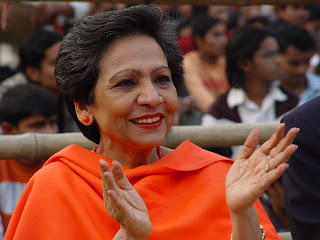 Geeteara Safiya Choudhury: What does one say about one’s mother? She is all that and more. And more importantly she is (or should I say was???) my boss. I could write a thesis on her and still not be able to describe her fully. I learned many things from her but the values of honesty and hard work that she taught me are the most valuable. (Well atleast I practice one of them!). From a very young age I knew that my mother was different from others. I could go to her with anything and get a patient hearing without being judged. And that I’ve seen is true even now at work. On her desk sits a small plaque that I had bought her that says “Mother is one who can take anyone’s place but whose place no one else can” . True!
 Rokia Afzal Rahman: What does one say about one’s mother-in-law? Well she is nothing like the stereotype that is butt of “mom-in-law” jokes. I’ve known Roki Aunty since I was a kid. She being my mother’s friend, I heard great tales about this person since eons. But I really got to know her after I got married. To my utter delight I found a wonderful person. And since my father-in-law’s demise found a strong and level-headed one. I am still amazed by how friendly she can get. It is a matter of minutes before she starts a conversation with a complete stranger. And a few more minutes before they are friends. I am sure not many people can truly say that they are good friends with their mother-in-law. I can.

Faiza Rahman: This is the tricky one. And only because I just don’t know where to begin and where to end. She is my best friend and confidant. She is my anchor and my engine. She is my present and my future. She is my wife. I guess many can claim that their wives are the same. But I know she is different. I am mesmerised by her beauty and awe struck by her intelligence. I often wonder how she can take so good care of me. (Ok confession time: I do absolutely nothing to help out in the house). These days it is uncanny how we begin to finish each other’s sentences and thoughts. I just I wish I could sing, then I’d sing her the world.
 Fahima Choudhury: I’ve known her all her life. And she has known me most of mine. We were born just 2 years, 2 months and 9 days apart (those 9 days mattered when you were young). We grew up together as friends. I don’t remember any sibling rivalry growing up. A lot of fights maybe! But mostly because I figured out what fun it was to see her get angry. Despite this Keya and I had the most fun growing up together. Our summer trips to Sylhet. Our cycle rides in my father’s office (Sherlock Snoopy Roger that!) Us figuring out who got a bigger share of Coke left over from last evening’s party. Kodai. And her borrowing money from me for not having “change” for a Taka 500 note [the bill being Tk 475!!] She is one of the most capable and intelligent persons I know. And I know many.
 Yasmeen Murshed: the only non-family on the list. I guess that makes her special. But she is. These days it seems to be fashionable to blame her school and her for so many things. But I never do get it. She taught me most of what I know. Well not only academically speaking but also about one’s sense of responsibility, patriotism and belief in one’s abilities. Even as the principal of my school, she never used to impose her will on us. She used to encourage us to challenge her. She pretended that we were her intellectual peers and engaged us. Not as mere school boys but rather as men.
I know, I know. Many will think I’m sucking up big time. But here is the truth on why I wrote this. These days it is very common to hear conversation about “these two ladies” who have ruined our nation. And this thought is often taken forward and argued as a fault of their gender in general. But that this is so, so far from the truth. These five ladies prove beyond a doubt in my mind that it is not gender that should be a discriminator.
 Geeteara Safiya Choudhury: What does one say about one’s mother? She is all that and more. And more importantly she is (or should I say was???) my boss. I could write a thesis on her and still not be able to describe her fully. I learned many things from her but the values of honesty and hard work that she taught me are the most valuable. (Well atleast I practice one of them!). From a very young age I knew that my mother was different from others. I could go to her with anything and get a patient hearing without being judged. And that I’ve seen is true even now at work. On her desk sits a small plaque that I had bought her that says “Mother is one who can take anyone’s place but whose place no one else can” . True!
 Rokia Afzal Rahman: What does one say about one’s mother-in-law? Well she is nothing like the stereotype that is butt of “mom-in-law” jokes. I’ve known Roki Aunty since I was a kid. She being my mother’s friend, I heard great tales about this person since eons. But I really got to know her after I got married. To my utter delight I found a wonderful person. And since my father-in-law’s demise found a strong and level-headed one. I am still amazed by how friendly she can get. It is a matter of minutes before she starts a conversation with a complete stranger. And a few more minutes before they are friends. I am sure not many people can truly say that they are good friends with their mother-in-law. I can.
Faiza Rahman: This is the tricky one. And only because I just don’t know where to begin and where to end. She is my best friend and confidant. She is my anchor and my engine. She is my present and my future. She is my wife. I guess many can claim that their wives are the same. But I know she is different. I am mesmerised by her beauty and awe struck by her intelligence. I often wonder how she can take so good care of me. (Ok confession time: I do absolutely nothing to help out in the house). These days it is uncanny how we begin to finish each other’s sentences and thoughts. I just I wish I could sing, then I’d sing her the world.
 Fahima Choudhury: I’ve known her all her life. And she has known me most of mine. We were born just 2 years, 2 months and 9 days apart (those 9 days mattered when you were young). We grew up together as friends. I don’t remember any sibling rivalry growing up. A lot of fights maybe! But mostly because I figured out what fun it was to see her get angry. Despite this Keya and I had the most fun growing up together. Our summer trips to Sylhet. Our cycle rides in my father’s office (Sherlock Snoopy Roger that!) Us figuring out who got a bigger share of Coke left over from last evening’s party. Kodai. And her borrowing money from me for not having “change” for a Taka 500 note [the bill being Tk 475!!] She is one of the most capable and intelligent persons I know. And I know many.
 Yasmeen Murshed: the only non-family on the list. I guess that makes her special. But she is. These days it seems to be fashionable to blame her school and her for so many things. But I never do get it. She taught me most of what I know. Well not only academically speaking but also about one’s sense of responsibility, patriotism and belief in one’s abilities. Even as the principal of my school, she never used to impose her will on us. She used to encourage us to challenge her. She pretended that we were her intellectual peers and engaged us. Not as mere school boys but rather as men.
 I know, I know. Many will think I’m sucking up big time. But here is the truth on why I wrote this. These days it is very common to hear conversation about “these two ladies” who have ruined our nation. And this thought is often taken forward and argued as a fault of their gender in general. But that this is so, so far from the truth. These five ladies prove beyond a doubt in my mind that it is not gender that should be a discriminator.
Thursday, February 22, 2007
The New Adventures of Doc Y

Trouble brewed in Gotham City. The evil empress KZdam attacked mercilessly, while her henchman the Clown cleared out the bank vaults. On the other side of town the Hissina spewed venom on all that was good. Everyone ran helter-skelter. Is there no respite from this hell on earth? Will we never return to the days of the good? Is our salvation, our promised land just a dream? Just then across the sky, blazed a light. We looked up and asked, “Is it a social worker? A businessman? A politician?” “No!” came the reply “It’s Doc Y!”
Okay, I am prone to hyperbole. But I needed to match the dramatics that the good Dr. created with his letter to the nation. First of all as a practitioner of the art of Public Relation, I thought this move by him was a pure stroke of genius. Unfortunately it is the only one that I have seen from him in the recent past.
What surprised me the most was that the reaction was not, like I expected it to be, all saying this is the best thing since Mama’s Halim. Regardless of which newspaper you turned to, the balance between the yah-sayers and the nay-sayers was, I would say, a 55:45 split! The biggest argument in the positive side being that “give the man a chance” and on the other, “he can never succeed.”
What was my reply to the open letter? I was torn. Doc Y and I, as those who read my writing know, have a love-hate relationship. Well a relationship, if you take into consideration that I do not think he ever does read my writings. But as I’ve always maintained, he has this immense capability of luring me with his hypnotic spell of doing-good, only to leave me standing all alone at the alter. Be it the Citizen’s Anti Corruption Council or the need to find Clean Candidates. I wonder why I get a sense of déjà vu?
If I want to give him the benefit of the doubt, Dr. Yunus’ latest adventure is a very well meant attempt. He has, if nothing else, an innate understanding of where he sees Bangladesh heading and he has the ability to rally popular support behind that. I believe one of our nation’s biggest problems is the lack of vision of our leaders. Dr. Yunus brings a remedy to that problem.
I also hope his foray into politics will break the myth that there is no place for good honest citizens in nation building or in politics. I wish that I had a taka for every time someone told me that I would not be a successful politician because I did not have the requisite talent in corruption and mastan-giri. I pray the beacon of hope is lit and that many more flock to the arena.
But personal honesty or unremitting charisma cannot be the only criteria for successful politics or for the ability to manage the affairs of a state. A “clean-and-honest” candidate is not the end itself. But rather it is one of the many requirements for a successful statesman. I am sure that just about now I’ll be hit by the argument that Dr Yunus has managed the growth of Grameen Bank and its subsidiaries quite successfully. I would love to get into the debate about what are the parameters to measure success but I think that will derail from my main premise. I do not think Dr. Yunus will be successful in his efforts.
“Why?” you ask. Well for one he has been extremely politically naïve in the last few months (if not longer). He made more than several well-documented blunders. Say by giving President Iajuddin an “A+” when the rest of the nation looked on helplessly. Or the fact that he came up with the desire to go into polls come what may. Or even the fact that he towed the BNP line of constitutional requirement of the polls by a certain time, only to abandon it when the new caretaker government took oath. This coupled with his ill thought out “clean-candidate” speech, makes me question the capability of his advisers. Or for that matter if at all he is taking any advice to start with. And if he is, from whom is it coming?
Some of the events of the last few weeks have bewildered me. For one the fact that Dr. Yunus is so blatantly circumnavigating the current Emergency ordinance prohibiting any political activity. Secondly that he has asked people to form “Preparatory Committees” of 20 people at local level. Now who will be a part of these committees? Of course it would be nice if a common Joe (or in this case Jamal) would sign up. But is this not open to any and sundry to join? How do you identify who is a genuine “Yunuster” and who is an opportunist? I am not even getting into where the funding for such a large-scale mobilisation will come from. But let us not be naïve to think that no money is required to build up a grassroots based organisation. Are we looking at Grameen Foundation, vested interests or even a foreigner like George Soros to give the money?
Well to sum up my case, I believe that Dr. Yunus’ escapade into politics is, while well-intentioned, full of holes big enough to make any political observer squirm in his armchair. I know, I know! The nation is crying out for a change. By my own reporting 53% of the voters have lost faith in both the main political parties. Does it not leave an opportunity for a third force to emerge? Yes it does. But I don’t think Dr Yunus needs to be this force. And even more worryingly I have a feeling he is headed down the Gono Forum route.
Don’t get me wrong. I am not opposed to Dr. Yunus having a role in the government. But I think that he needs to rise above the political divide. We do not need another player in the field. It would not even matter that he is a Pele. What we actually do need is a good referee. Though he dismissed it offhandedly, I thought a better position for him to assume is that of the President of Bangladesh. While he is right that this is currently a mere ceremonial role, I would have thought he has the prudence to see the bigger picture. Not all powers have to be vested. Some come when one earns it through courage, respect, forbearance and integrity. For example Mahatma Gandhi never had a constitutionally mandated role in India. But can we ever overestimate his influence in the events of his times? Or what about the ceremonial Presidents of India? Most of them have left indelible mark on his nation’s conscience. In Thailand the King is a constitutional monarch. But a mere suggestion from him can sway a nation. Could Dr. Yunus not play the role of the Chief Vision Architect of the nation? As the President he can guide our collective actions into the right path. He could act as a political ombudsman to the brawling parties that govern us. He could be mentor to the young and a friend to the poor. He could shower us with hope, faith and aspirations. He could actually be the answer we are looking for instead of the debate we are getting into.
Does it mean that I’ll not vote for Nagorik Shakti, let alone support it? Like I said, I am torn. I just hope that Dr. Yunus has the foresight to surround himself with able people, from whom he can get solid advice. Unlike Grameen Bank, governing the country is a different beast. Despite being owned by “poor women of Bangladesh” the former has always been the autocratic fiefdom of its founder. Now he is potentially the head of an organisation that has 140 million often vocal “shareholders”. Only way he can manage this is through investing in a team. He needs to build consensus while delegating responsibility. The first signs of the longevity of his experimentations with politics will be in the constitution of his core team. For that the nation waits anxiously.
While I think Doc Y will not succeed, I do want him to. More importantly I want Bangladesh to benefit from his dreams. Either each way, I think the sky over Gotham has changed forever.
For further of my writings on Dr Yunus you might want to read:
* http://nazimfarhan.blogspot.com/2005_06_01_nazimfarhan_archive.html#links
* http://nazimfarhan.blogspot.com/2006/08/my-love-affair-with-dr-yunus.html
* http://nazimfarhan.blogspot.com/2006/10/dr-yunus-launching-platform.html
* http://nazimfarhan.blogspot.com/2006/10/this-or-that.html
* http://nazimfarhan.blogspot.com/2006/10/dr-y-dr-k-dr-b.html
Wednesday, February 21, 2007
Bangla & I
I find it ironic that I am sitting here writing what “Bangla” means to me in English. But what is Bangla to me? Is it a language? Is it a means of communication? Is it an identity?
At some levels I represent a certain group of young citizens of Bangladesh who are caught in a self-conscious gap. Having spent my school days in a Dhaka based English medium school in the 1980s I was isolated from our mother tongue. Then spending my college days in foreign lands, I got comfortable with even thinking in English. I became what is termed as a “TCK – Third Culture Kid”, looked on as a stranger by both my native tongue and in the language I am most comfortable in.
Now, “my-school-did-not-teach-me-I-am-a-TCK” excuse does not absolve me of my sin of not making the effort to get comfortable with the language. Many of my generation did. My wife for one is nagging me to take her to the Ekushay Boi Mela. I get very ashamed when I cannot place a literary reference from the rich Bangla masterpieces. Given my love for reading I feel I have cheated myself out of an engagement that I would have cherished. One caveat though – I used to be a voracious reader of the Bangla satirical comic Unmad.
I have been back in Dhaka for the last 13 years. Over that time my interaction with Bangla has evolved. Though I still do my thinking and writing in English, my chorcha is getting more intense. I spend a lot of effort in going through a wonderful blog site called somewhereinblog.com. With the promise of being the sound of a new revolution it is a site that has various stimulating and engaging conversations happening on diverse topics. Bangla language bloggers from across the world use this as a new medium to exchange ideas. Ironic part of the process is that this site was actually founded by a Norwegian gentleman.
Does that not beg us to ask the question, does our language actually belong to anyone? Or even what the dynamics of a language should be? English for one is a living-breathing animal that morphs depending on which part of the world you are from. Hinglish spoken in India is different from the Spanglish made popular by the Hispanic immigrants in the US. Chicken English of Jamica is not even close to any two Singaporeans speaking. Why, even the Queen’s “territories” of Australia or Scotland or Canada have vastly different interpretations of Her Language. Now before you go splitting dialects with me let me argue it is not the same as the difference between Sylheti and Noakhali. All you need to do is ask a Cockney speaker for directions.
While it is true that there is a difference between cholti and shuddho Bangla, we have been guarding the development of the language quite parochially. In recent times a very visible experiment with the language was through a controversial advertising campaign for a cell-phone campaign aimed at the youth. Oh what hue and cry it created from the purists. Our cultural leaders missed out on the fact that the youth of any generation develop their own lingo. This classifies them and bonds them at a certain level. And as much as you try you cannot muffle this kothin bhaab. The language is not the sole domain of a library or of Bangla Academy. Isn’t the name itself a glaring inconsistency of purpose? No one owns the language. Rather it is owned by all. It is as much the kingdom of a Bhasha Shoinik as it is of an English-medium educated brat.
If Bangla does not belong to me then do I belong to Bangla? And here is where I get clarity. Bangla to me is not a language. It is an essence of my being. Of course it is a language. An important language at that. I still remember my grandmother pleading with me before I went abroad for my study, if I was to marry a bideshi I should ensure she spoke Bangla. Otherwise she could not speak her monerkotha.
But in my mind it is so much more.
In one level it is an identity. Stand at a street corner in Rome and talk loudly in Bangla and you will make so many new friends. Bangladeshi immigrants there will open up their homes and hearts just because you are a deshi bhai.
In another level it is culture. Habib in recent times started a revolution of sorts. It is now so okay to enjoy Bangla music without feeling guilty of- depending on which side of the scale you stand- listening to dance music or to folk song.
And in even other it is an emotion. Unless I say “Dosto” to my friends, or “array aita josh toh” I don’t think the essence of what I am feeling is communicated properly.
Bangla to me is different things. It is a language. It is a means of communication. It is an identity. And most importantly it is a state of mind. Just because I use English more fluently does not mean I am not proud of my language or I am an alien to my culture. My great grandfather Dr. Mohammed Shahidullah was a renowned linguist who reportedly knew more than 26 languages plus tens of dialects. He was one of the proponents of the language (hence Bangla) being the rational of dividing the British Raj instead of religious ones. But when he came out of a stroke, for the first few days he only spoke in French. Does it mean that he was not a patriot? Or he was not a Bangali?
In the case of all of Bangladesh as a collective, I argue, the relationship should be the similar. Yes it is our nation’s language but we should not look at it only as a cultural treasure. We should nurture it and let it flourish. Our language is strong enough to stand the rigors of experimentation. So what if a song or poetry or an advertisement or two people in a conversation mix English, Spanish, Chinese or any other tongue with Bangla. Does it make it weak? No I say. What we are allowing is for it to stand on its own two feet, without needing to mollycoddle it with fervour of a first time mother. Often in our zeal to protect our culture and identity we forget that we live in an interconnected world. If we cannot communicate with this world we will not be looked as an equal participant.
As an IT practitioner I salivate with the prospect of harnessing the power of our 140+ million minds. But the reality is that because of xenophobic educational policy decision of the mid 80s, today we are notoriously short of people who can string an English sentence together. Because of this we can never be a serious world player in the ever-growing voice based BPO (Business Process Outsourcing) industry. Similarly our young boys and girls often meet a roadblock in their corporate career paths. If only we had a robust educational policy with a strong language component, we could be exporter of managerial and technical resource around the world. Just like our neighbour.
Bangla is a beautiful language. It is an identity. It is a culture. It is in all her glory, an art form. What it should not be is a shackle. In our need to be puritans we should not sacrifice our prosperity. While we should continue to promote our language, we should not be closed to prospects others bring. Let us not be scared. While we are mere mortals our language will live forever.
At some levels I represent a certain group of young citizens of Bangladesh who are caught in a self-conscious gap. Having spent my school days in a Dhaka based English medium school in the 1980s I was isolated from our mother tongue. Then spending my college days in foreign lands, I got comfortable with even thinking in English. I became what is termed as a “TCK – Third Culture Kid”, looked on as a stranger by both my native tongue and in the language I am most comfortable in.
Now, “my-school-did-not-teach-me-I-am-a-TCK” excuse does not absolve me of my sin of not making the effort to get comfortable with the language. Many of my generation did. My wife for one is nagging me to take her to the Ekushay Boi Mela. I get very ashamed when I cannot place a literary reference from the rich Bangla masterpieces. Given my love for reading I feel I have cheated myself out of an engagement that I would have cherished. One caveat though – I used to be a voracious reader of the Bangla satirical comic Unmad.
I have been back in Dhaka for the last 13 years. Over that time my interaction with Bangla has evolved. Though I still do my thinking and writing in English, my chorcha is getting more intense. I spend a lot of effort in going through a wonderful blog site called somewhereinblog.com. With the promise of being the sound of a new revolution it is a site that has various stimulating and engaging conversations happening on diverse topics. Bangla language bloggers from across the world use this as a new medium to exchange ideas. Ironic part of the process is that this site was actually founded by a Norwegian gentleman.
Does that not beg us to ask the question, does our language actually belong to anyone? Or even what the dynamics of a language should be? English for one is a living-breathing animal that morphs depending on which part of the world you are from. Hinglish spoken in India is different from the Spanglish made popular by the Hispanic immigrants in the US. Chicken English of Jamica is not even close to any two Singaporeans speaking. Why, even the Queen’s “territories” of Australia or Scotland or Canada have vastly different interpretations of Her Language. Now before you go splitting dialects with me let me argue it is not the same as the difference between Sylheti and Noakhali. All you need to do is ask a Cockney speaker for directions.
While it is true that there is a difference between cholti and shuddho Bangla, we have been guarding the development of the language quite parochially. In recent times a very visible experiment with the language was through a controversial advertising campaign for a cell-phone campaign aimed at the youth. Oh what hue and cry it created from the purists. Our cultural leaders missed out on the fact that the youth of any generation develop their own lingo. This classifies them and bonds them at a certain level. And as much as you try you cannot muffle this kothin bhaab. The language is not the sole domain of a library or of Bangla Academy. Isn’t the name itself a glaring inconsistency of purpose? No one owns the language. Rather it is owned by all. It is as much the kingdom of a Bhasha Shoinik as it is of an English-medium educated brat.
If Bangla does not belong to me then do I belong to Bangla? And here is where I get clarity. Bangla to me is not a language. It is an essence of my being. Of course it is a language. An important language at that. I still remember my grandmother pleading with me before I went abroad for my study, if I was to marry a bideshi I should ensure she spoke Bangla. Otherwise she could not speak her monerkotha.
But in my mind it is so much more.
In one level it is an identity. Stand at a street corner in Rome and talk loudly in Bangla and you will make so many new friends. Bangladeshi immigrants there will open up their homes and hearts just because you are a deshi bhai.
In another level it is culture. Habib in recent times started a revolution of sorts. It is now so okay to enjoy Bangla music without feeling guilty of- depending on which side of the scale you stand- listening to dance music or to folk song.
And in even other it is an emotion. Unless I say “Dosto” to my friends, or “array aita josh toh” I don’t think the essence of what I am feeling is communicated properly.
Bangla to me is different things. It is a language. It is a means of communication. It is an identity. And most importantly it is a state of mind. Just because I use English more fluently does not mean I am not proud of my language or I am an alien to my culture. My great grandfather Dr. Mohammed Shahidullah was a renowned linguist who reportedly knew more than 26 languages plus tens of dialects. He was one of the proponents of the language (hence Bangla) being the rational of dividing the British Raj instead of religious ones. But when he came out of a stroke, for the first few days he only spoke in French. Does it mean that he was not a patriot? Or he was not a Bangali?
In the case of all of Bangladesh as a collective, I argue, the relationship should be the similar. Yes it is our nation’s language but we should not look at it only as a cultural treasure. We should nurture it and let it flourish. Our language is strong enough to stand the rigors of experimentation. So what if a song or poetry or an advertisement or two people in a conversation mix English, Spanish, Chinese or any other tongue with Bangla. Does it make it weak? No I say. What we are allowing is for it to stand on its own two feet, without needing to mollycoddle it with fervour of a first time mother. Often in our zeal to protect our culture and identity we forget that we live in an interconnected world. If we cannot communicate with this world we will not be looked as an equal participant.
As an IT practitioner I salivate with the prospect of harnessing the power of our 140+ million minds. But the reality is that because of xenophobic educational policy decision of the mid 80s, today we are notoriously short of people who can string an English sentence together. Because of this we can never be a serious world player in the ever-growing voice based BPO (Business Process Outsourcing) industry. Similarly our young boys and girls often meet a roadblock in their corporate career paths. If only we had a robust educational policy with a strong language component, we could be exporter of managerial and technical resource around the world. Just like our neighbour.
Bangla is a beautiful language. It is an identity. It is a culture. It is in all her glory, an art form. What it should not be is a shackle. In our need to be puritans we should not sacrifice our prosperity. While we should continue to promote our language, we should not be closed to prospects others bring. Let us not be scared. While we are mere mortals our language will live forever.
Subscribe to:
Posts (Atom)